- HOME
- MONUMENT
- Convent of Christ
- History
- Architecture
- Personalities
- King Afonso Henriques
- D. Gualdim Pais
- King Dinis
- King John I
- D. Lopo Dias de Sousa
- King Duarte
- Prince D. Henrique (Henry
- King John II (1455 - 1495
- King Manuel I (1469 - 152
- Diogo de Arruda
- João de Castilho
- Jorge Afonso
- Olivier de Gand
- King John III (1502 - 155
- Diogo de Torralva
- Friar Anthony of Lisbon
- Baltazar de Faria
- Filipe Terzi
- Philippine Dinasty
- King Philip II of Spain
- King John IV
- Domingos Serrão
- Queen Mary II
- Prince Fernando
- Costa Cabral
- Artisans and Artists
- Intangible Heritage
- Related Heritage
- Glossary
- VISIT OUR MONUMENT
- HERITAGE LEARNING
- TOMAR
- MONASTERIES ROUTE

King Manuel I (1469 - 1521)
D. Manuel, Duke of Beja and grandson-nephew of Infante D. Henrique, received the Mastery dignity of the Order of Christ around 1485, after the passing of his brother, D. Diogo, Duke of Viseu, Governor and Keeper of that chivalry order.
After the death King John II´s son and heir - Infante D. Afonso - in 1491, D. Manuel, his cousin and brother-in-law, is appointed heir to the Portuguese throne. Thus King Manuel is Governor and Keeper of the Order of Christ and King of Portugal between 1495 and 1521. During this period, the Militia of Christ has an unparalleled involvement in the royal policy of maritime expansion.
This involvement is manifested in the designation of friar knights of the Militia as sea captains as well as of discovered or conquered lands. Also, new commendations were ordered within the kingdom and in overseas territories. The first thirty commendations of Tomar occurred in 1503 for sites in Africa, to be provided, exclusively, for friar knights of the militia that had continuously serviced within that territory.
From 1514 onwards, following various papal notices, King Manuel I will be able to use the money from various rents of convents and parishes to finance two hundred new commendations in order to consolidate his action overseas. In effect King Manuel uses the Order of Christ as his chivalry order of excellence and a tool of his monarchic power.
After the death King John II´s son and heir - Infante D. Afonso - in 1491, D. Manuel, his cousin and brother-in-law, is appointed heir to the Portuguese throne. Thus King Manuel is Governor and Keeper of the Order of Christ and King of Portugal between 1495 and 1521. During this period, the Militia of Christ has an unparalleled involvement in the royal policy of maritime expansion.
This involvement is manifested in the designation of friar knights of the Militia as sea captains as well as of discovered or conquered lands. Also, new commendations were ordered within the kingdom and in overseas territories. The first thirty commendations of Tomar occurred in 1503 for sites in Africa, to be provided, exclusively, for friar knights of the militia that had continuously serviced within that territory.
From 1514 onwards, following various papal notices, King Manuel I will be able to use the money from various rents of convents and parishes to finance two hundred new commendations in order to consolidate his action overseas. In effect King Manuel uses the Order of Christ as his chivalry order of excellence and a tool of his monarchic power.
It is with King Manuel that the Order will have its most profound involvement in the Discoveries enterprise - both spiritually, by giving the Order the ecclesiastic of the overseas parishes, as well as in temporal terms, with the exemption of the chastity vow for the knights who wished to raise a family overseas. With King Manuel, the Order holds immense power spread out throughout the Portuguese empire.
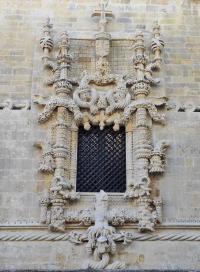
King Manuel I called on the greatest artists and craftsmen of his time to work at the Convent of Christ. The highlights have to go to Diogo de Arruda and João de Castilho for their work and importance in the architectural history of this Monument.
King Manuel I died in Lisbon on December 13th, 1521 and was buried in the Jerónimos Monastery.
King Manuel I called on the greatest artists and craftsmen of his time to work at the Convent of Christ. The highlights have to go to Diogo de Arruda and João de Castilho for their work and importance in the architectural history of this Monument.
King Manuel I died in Lisbon on December 13th, 1521 and was buried in the Jerónimos Monastery.
SERVICES - ACTIVITIES
HIGHLIGHTS