- HOME
- MONUMENT
- Convent of Christ
- History
- Architecture
- Personalities
- King Afonso Henriques
- D. Gualdim Pais
- King Dinis
- King John I
- D. Lopo Dias de Sousa
- King Duarte
- Prince D. Henrique (Henry
- King John II (1455 - 1495
- King Manuel I (1469 - 152
- Diogo de Arruda
- João de Castilho
- Jorge Afonso
- Olivier de Gand
- King John III (1502 - 155
- Diogo de Torralva
- Friar Anthony of Lisbon
- Baltazar de Faria
- Filipe Terzi
- Philippine Dinasty
- King Philip II of Spain
- King John IV
- Domingos Serrão
- Queen Mary II
- Prince Fernando
- Costa Cabral
- Artisans and Artists
- Intangible Heritage
- Related Heritage
- Glossary
- VISIT OUR MONUMENT
- HERITAGE LEARNING
- TOMAR
- MONASTERIES ROUTE

Convent of Christ
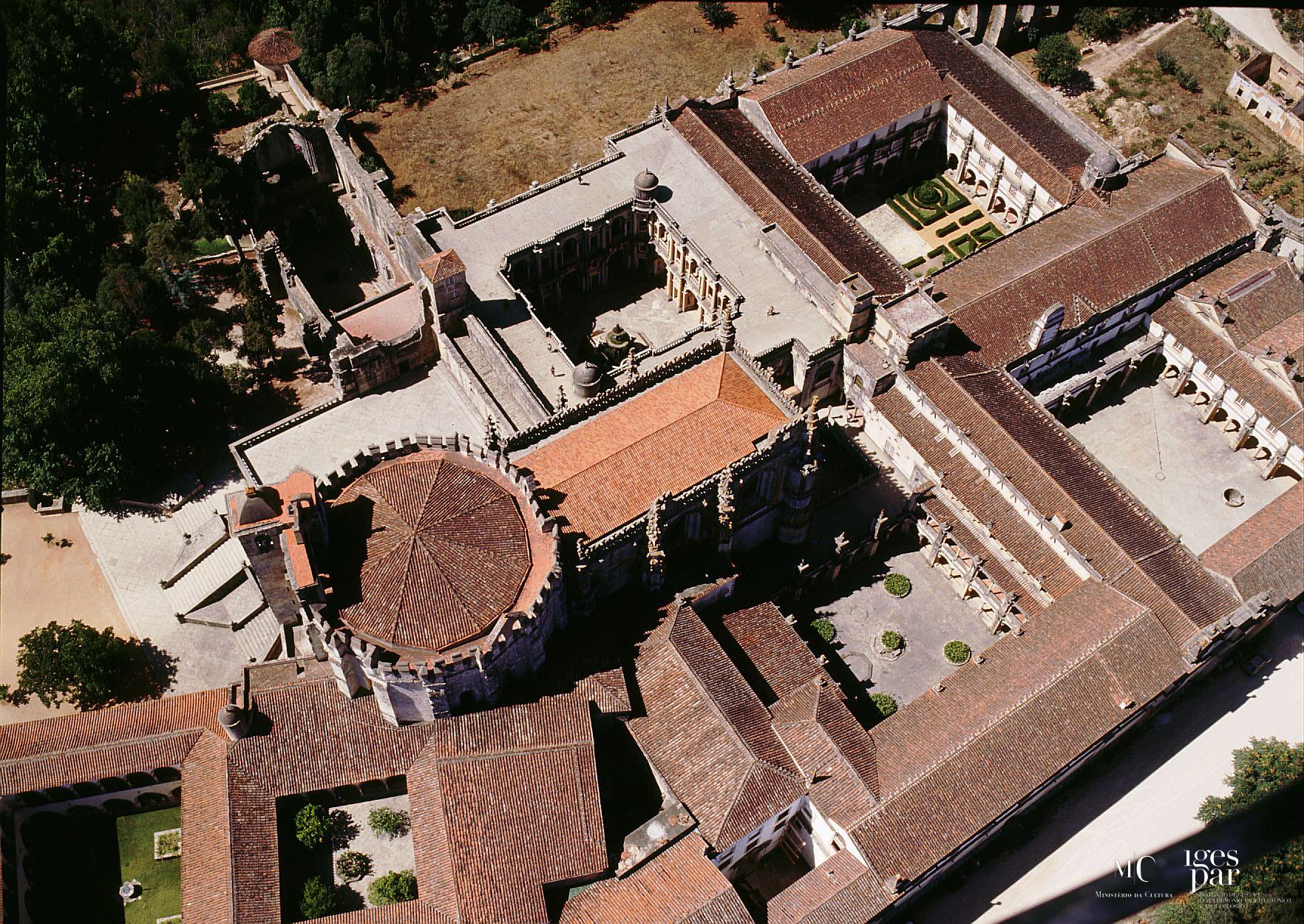
Convent of Christ is the name usually given to the monument ensemble consisting of the Templar Castle of Tomar, the Order of Christ convent of Rebirth, the conventual wall - now known as the Seven Hills Woods, the Immaculate Conception Hermitage and the conventual aqueduct also known as the Pegões Aqueduct. The castle had its foundation in 1160 and comprised the walled village, the yard and the military house situated between the Master´s house - the Alcáçova (fortified citadel with a sovereign residence), the knight's round-shaped Oratorium known as Charola, finished in 1190.
In 1420, as headquarters of the Order of Christ, Infante D. Henrique, o Navegador, (Henry the Navigator) transforms the military house into a convent to be used by the contemplative clergymen that he introduced into the Order and adapts the Alcáçova as his seigniorial home.
In the beginning of the 16th century, D. Manuel I, King and Governor of the Order of Christ extends the Templar Rotunda to the west, with a new construction beyond the walls, laden with decorative motifs celebrating the Portuguese maritime discoveries, the mysticism of the Order of Christ and the Crown in a grandiose manifestation of power and faith.
With the reform by King John III of the Order of Christ from 1531 onwards, a grand convent of rebirth, opposite the western wing of the castle and surrounded by the Manueline Nave. The convent is finished with the construction of the 6km long aqueduct by the hand of King Philip II of Spain (Philip I of Portugal), and with the construction of the Infirmary and the Pharmacy in the era after the independence Restoration War.
This group of spaces, built throughout the centuries, makes the Convent of Christ a grandiose monument complex that earned the UNESCO Heritage of Mankind distinction.
World Heritage

Tomar Castle and the Convent of Christ - headquarters for the religious and military orders of the Temple and of Christ - were awarded the UNESCO Heritage of Mankind classification and enrolled in UNESCO´s list of World Heritage in 1983. (...)
Click here to find out more
The Space and the Time

The Convent of Christ and the Knights Templar Castle are part of one of the largest monument complexes of peninsular and European architecture - both in size and durability. (...)
Click here to find out more
The Monumental Complex

The monumental complex that is the Convent of the Order of Christ began with the construction the Castle of the Knights Templar in 1160. Work on the Templars’ Oratory or Charola commenced at the same time. These works were completed at the end of the 12th (...)
Click here to find out more
Tomar Castle

Tomar is born from the donation by King Afonso Henriques in 1159 of the Ceras Castle to the Knights Templar. The territory was crossed in the south by the Tomar river - with its fertile valley to the west with very step foothills. It was in one of those f (...)
Click here to find out more
Charola

The Charola was the Knight´s private oratorium within the fortress. Its typology was similar to the byzantine churches which integrated the Romanesque with the Crusades movement. (...)
Click here to find out more
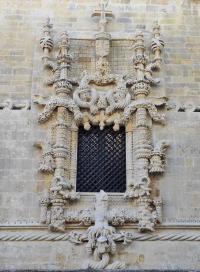
Chapter House Window

The Manueline Nave is garnished - both inside and outside - by profuse sculptural symbolic ornamentations, heraldic and sacred. All of the architectural elements - talon, pinnacles, buttresses, windows, etc - are surrounded by a profound plasticity due to (...)
Click here to find out more
Main Cloister

The Main Cloister is the major work of the Renaissance convent built by King John III, situated outside the castle walls and surrounding the nave that his father - King Manuel I - used to extend the Templar church. (...)
Click here to find out more
Conventual Wall. Woods of the Seven Hills

The conventual Wall is a vast rural area known since the beginning of the Templar settlement era as Place of the Seven Hills. (...)
Click here to find out more
N. Srª. da Conceição (Our Lady of Conception) Hermitage

The Reform of the Order of Christ ordered by King John III and carried out by Jerome Friar António Moniz de Lisboa brought to Tomar a Renaissance jewel: The Immaculate Conception Hermitage. (...)
Click here to find out more
Convent Aqueduct

Even though the joanino convent reservoirs were sufficient to cater to the friars ´needs, the available water was not sufficient for the cultivation of the terrains of the conventual church. (...)
Click here to find out more
New Infirmary and Pharmacy

During the Restoration war King John IV gives continuity to the Works at the Convent - previously suspended during Spanish kings Philipe II and Philipe III´s reigns. In 1641, he nominates Pero Vaz Ferreira as the convent´s architect. (...)
Click here to find out more
SERVICES - ACTIVITIES
HIGHLIGHTS